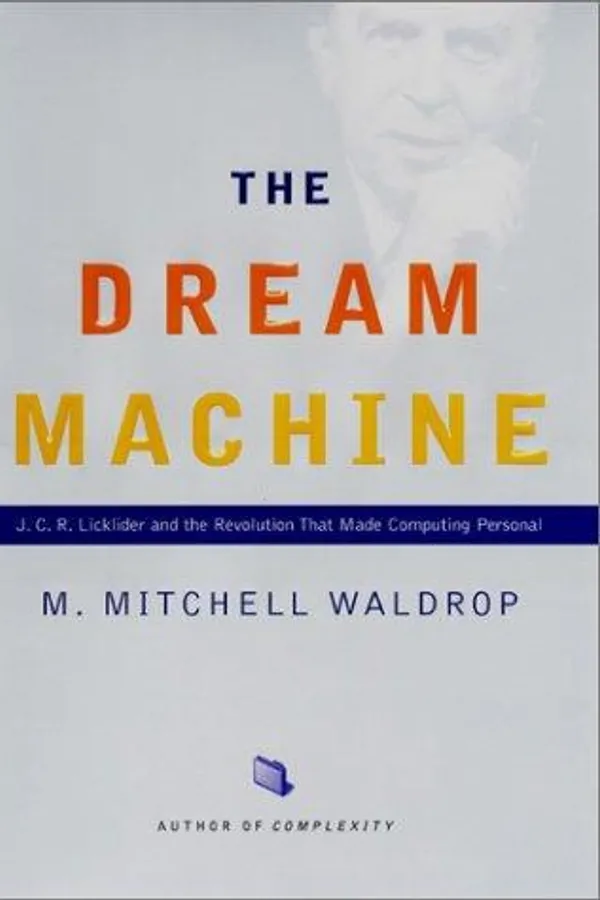
Book
The Dream Machine
M. Mitchell Waldrop
Personal, interactive, networked computing was not an accident of markets; it was the deliberate project of one psychologist who paid for it before it was possible.
- TYPE
- Book
- SHELF
- Technology & Systems
- TIME
- 14 min read
- ADDED
- 2026 · 07 · 07
- STATUS
- Completed
- IDEAS
Technology · History · AI
Why it matters
Every system I build assumes a human and a machine thinking together; this book is the record of where that assumption was purchased, and by whom.
Waldrop's history runs from Vannevar Bush's Memex and Wiener's cybernetics through MIT's Whirlwind and the SAGE air-defense system to ARPA and Xerox PARC, and it is held together by one man most people have never heard of. J.C.R. Licklider was a psychologist, a specialist in how humans hear, who came to computing sideways and saw in 1960 what almost no one building the machines saw: that the computer's destiny was not arithmetic but partnership, a symbiosis in which the machine handles the clerical work of thought and the human supplies judgment and purpose. Then he was handed the means to act on the conviction. As the first head of ARPA's Information Processing Techniques Office he funded time-sharing, interactive graphics, the AI laboratories, and Engelbart's augmentation work, chose brilliant people over defined deliverables, and wrote the half-joking memo about an intergalactic network that his successors turned into the ARPANET. The community he assembled outlived every one of its institutions, regrouped at Xerox PARC, and built the Alto, the machine the personal computer spent two decades imitating. Licklider built almost nothing himself and died in 1990, mostly forgotten. Waldrop's argument is that the world on your desk is his monument.
- Man-computer symbiosis, stated in 1960: the prize is not machines that replace human thought but machines that partner with it, absorbing the clerical so the human can supply the judgment.
- Fund people, not projects: Licklider's ARPA method was to find the best minds, give them room and money, and tolerate failure. It may be the highest-return capital allocation of the century.
- Interactive computing had to be taken from the batch-processing priesthood by force of budget; time-sharing was a political act before it was a technical one.
- The computer's real destiny was communication: Licklider and Taylor argued that the machine's future was as a medium between minds, and the ARPANET was that argument funded.
- Vision travels through communities, not documents. Licklider engineered a self-recognizing research community, and it carried the dream across four decades and a dozen dead institutions.
- PARC is the controlled experiment: given the ARPA people and industrial freedom, the whole future appeared within five years, and the corporation that paid for it could not see what it owned.
- A vision without a budget is a mood. The 1960 paper mattered because its author was handed signature authority two years later; the memo and the money must travel together.
The argument
Waldrop is writing against an absence. The standard folklore of computing runs from garages to IPOs, a story of markets discovering the personal computer, and it has no place for the fact the book is built on: nearly everything the folklore celebrates, interactive machines, graphical screens, the network itself, was specified as a vision and paid for with public money a decade or two before any market wanted it. The payer, for the years that mattered most, was a mild, joke-telling psychologist from Missouri named Joseph Carl Robnett Licklider, and the book’s task is to explain how a specialist in human hearing came to be the most consequential patron in the history of the technology.
The formation matters, and Waldrop spends real pages on it. Licklider was a psychoacoustician, trained on the question of how the brain turns pressure waves into meaning, and he came at computers as an instrument for studying minds, then as a colleague of them. The line of ancestors is drawn carefully: Vannevar Bush’s Memex, the imagined desk that would let a mind follow associative trails through the world’s knowledge; Wiener’s cybernetics seminars, where feedback and control made men and machines discussable in one vocabulary; Shannon making information itself a measurable quantity; von Neumann’s architecture giving the stored program its shape. Then the decisive accident of geography: MIT in the fifties, where Whirlwind and the SAGE air-defense project were building something almost nobody had seen, computers that ran in real time, with screens, responding to human operators as they worked. SAGE was a weapons system, and it was also, incidentally, the first demonstration that a human and a computer could hold a conversation worth having. Licklider, doing human-factors work in that world, was one of the few people positioned to see the incidental thing as the main thing.
His 1960 paper, Man-Computer Symbiosis, is the book’s keystone, and Waldrop presents it as a scientist’s argument rather than a prophecy. Licklider had clocked his own working days and found that most of what he called thinking was actually clerical: finding, transcribing, plotting, formatting, getting into position to think. The machine should take that share, not because it was intelligent but precisely because it was not, leaving formulation, judgment, and purpose to the human. He was explicit that this was a distinct program from artificial intelligence: not machines that think instead of us, and not machines used as glorified adding equipment, but a coupling, tighter than any tool, looser than any replacement. In 1960 this described no machine on earth. Batch processing ruled; the priesthood took your cards and returned your errors the next day; the computer was an oracle you petitioned, not a partner you thought with.
Then the story turns on money, which is where Waldrop’s history earns its keep. In 1962 ARPA, an agency built in the panic after Sputnik, hired Licklider to run a vague office concerned with command and control, and he committed a quiet, licensed fraud on his employers: he interpreted command and control to mean interactive computing in general, renamed the mission in practice, and began placing bets. The method was the innovation. He funded people, not deliverables: Project MAC at MIT for time-sharing, McCarthy’s and Minsky’s AI work, Newell and Simon at Carnegie Tech, Engelbart at SRI, whom nobody else would fund, and a network of graduate students he cultivated as deliberately as any investment. He wrote the memo, self-mocking in its title, addressed to the members and affiliates of the intergalactic computer network, that framed the obvious next problem: all these incompatible time-sharing islands needed to talk. And he built the succession, which is the part visionaries almost always neglect: Sutherland after him, then Bob Taylor, who in 1966, annoyed at the three separate terminals in his Pentagon office speaking to three separate systems, secured the money for what became the ARPANET, with Larry Roberts running the program and the first link alive in 1969. Licklider and Taylor’s 1968 essay had already stated the thesis under it: the computer’s destiny was to be a communication device, a medium between minds, and the network was that claim with a budget.
The last movement is Xerox PARC, and Waldrop plays it as the controlled experiment. When federal money tightened, Taylor assembled the cream of the ARPA community inside a corporation’s research campus with one instruction set: build the office of the future. Within roughly five years they had the Alto, a personal machine with a graphical display, the Ethernet to join Altos together, the laser printer, and Kay’s Smalltalk pointing at the Dynabook beyond. It was the symbiosis vision made into furniture, and Xerox, which had paid for all of it, could not see what it owned; the value walked out through demonstrations and departures into the industry that built the personal computer in the Alto’s image. Licklider by then had returned to MIT, served a bruising second tour at ARPA in leaner years, and faded into an honored obscurity. He died in 1990, one year before the web appeared, having built no famous machine, founded no company, and written comparatively little. Waldrop’s closing argument is the whole book compressed: the default assumption of modern life, that a computer is something an ordinary person converses with across a network, was one man’s conviction before it was anyone’s experience, and the conviction won because the man holding it briefly controlled the money.
Working notes
The book reads differently from the capital side of my life than from the engineering side. As engineering history it is a genealogy; as a study in allocation it is astonishing: the best venture portfolio of the century was run out of a defense agency by a psychologist with no financial training, and its method inverts nearly everything institutional capital now does. Long horizons instead of quarterly gates; people instead of plans; concentration in a community instead of diversification across strangers; failure tolerated as the price of variance. The portfolio returned the personal computer and the internet. No pension fund would have approved a single position in it.
Vision plus budget is the pairing I keep testing organizations against. The 1960 paper alone would have made Licklider a footnote, one more clever essay in a filing cabinet; the ARPA office alone, run by a routine administrator, would have bought better batch processing for generals. History moved because the conviction and the signature authority sat in the same chair for two years. I have stopped being impressed by corporate vision documents for exactly this reason: show me the allocation and I will tell you the actual vision. Strategy is what gets funded; the rest is stationery.
The symbiosis and AI fork is older than the current debate and the book proves it. Licklider funded the AI labs generously while betting his own conviction on augmentation, and the two programs, machines that replace thought and machines that partner with it, have been contesting the same buildings and budgets ever since. Engelbart, the purest augmentationist, was the man nobody but Licklider would fund; the field’s center of gravity kept drifting toward replacement because replacement makes the grander promise. Rereading this in the middle of the present AI cycle is vertiginous: the same fork, the same rhetoric, the same asymmetry of glamour, with the stakes multiplied.
Against Kidder, the book supplies the missing layer. The Soul of a New Machine is the basement view, engineers burning themselves down to ship one computer; The Dream Machine is the patronage view, the decisions two levels up that determined there would be basements at all. West’s engineers never met Licklider and were downstream of him anyway: the minicomputer industry, the interactive assumptions, the trained people, all flowed from the funding culture this book documents. Most engineering histories are written at the wrong altitude. This one is written at the altitude where the century actually pivoted, which is the altitude of the budget line.
And a note on community as infrastructure. Licklider’s most durable artifact was not a machine or a paper but a self-recognizing community, graduate students who knew each other, met, argued, and shared a dream that no single institution held. Institutions died repeatedly across this story; the community crossed each death intact, from MIT to ARPA to PARC to the industry. Whoever wants an idea to outlive his organization should study how deliberately that community was built: the contracts, the conferences, the succession. Ideas do not travel by themselves. They are carried.
Where I push back
Great-man history is a lens that produces the picture it looks for, and Waldrop, though honest about the risk, does not escape it. Threading a century of computing through one affable psychologist requires flattening the cases that do not fit: the parallel inventions, the researchers who arrived at interactivity without ever reading Licklider, the whole non-American history that barely appears. More seriously, it soft-pedals the patron behind the patron. The money was military money, appropriated for command and control in a nuclear standoff, and SAGE, the nursery of interactive computing, was a weapons system before it was a revelation. The dream rode on the war budget, and a fully honest account would hold both facts at equal weight instead of letting the dream take the foreground and the warheads the footnotes.
The hagiography also blurs Licklider’s own record where it weakens the thesis. He was, by the book’s own scattered evidence, a poor administrator in his later tours: the second IPTO period was a struggle, the institutions he had seeded outgrew his management, and his gift was placing bets, not running what the bets built. Waldrop records this and hurries past it. It matters, because the lesson readers take, the visionary should be given the institution, is half wrong: the visionary should be given the allocation window, and then relieved. Those are different job descriptions, and the book declines to separate them.
Finally, the story ends before the reckoning. Symbiosis assumed the machine’s interests were the user’s interests, a safe assumption when the machine was funded by research budgets and used by researchers. The conversational computer that actually arrived is funded by advertising, and the partner Licklider imagined amplifying human judgment now, in large deployments, harvests it. That is not Waldrop’s fault in 2001. But the book’s warmth invites a complacency the subject no longer permits: the dream was achieved, and the achievement is not neutral, and reading the book today without that shadow is reading it wrong.
How it enters the work
The symbiosis test is the closest thing Intelliblitz has to an acceptance criterion for AI systems. Before any enterprise deployment I ask Licklider’s question in modern dress: does this system extend the operator’s judgment or replace it, and if it replaces it, who now owns the error? The distinction is not sentimental; it is architectural. A system built for augmentation exposes its reasoning, keeps the human in the loop where the stakes concentrate, and makes the operator better at the job over time. A system built for replacement optimizes the human out and then fails silently at the edge cases the human used to catch. Enterprise buyers arrive speaking the replacement language because that is where the glamour is; the engagement usually consists of walking them back to symbiosis before the design hardens. I did not invent that argument. I inherited it from a 1960 paper, through this book.
The funding method governs how I allocate inside my own firms. Discovery work, the experiments that might become practice areas, gets funded Licklider-style: a person I believe in, room, time, and tolerance for dead ends. Delivery work gets funded as projects: scope, dates, accountability. The two modes are kept deliberately separate, because the book shows what each produces and what happens when they are confused; project discipline applied to discovery kills it, and discovery freedom applied to delivery is how consultancies rot.
And the community lesson shapes how engagements end. A client’s transformation survives our departure only if a community inside the client carries it: the trained engineers, the design forums, the people who recognize each other as owners of the system. So we build that deliberately, the way Licklider built his: succession named, knowledge moved into the client’s people, the system theirs rather than rented from us. Waldrop’s book is the proof at historical scale that this is what actually persists. The machines in his story all became museum pieces; the community shipped the future. I take the point personally: the durable output of a builder is rarely the artifact. It is the people who can build the next one, and the conviction, funded early enough, that they should.
- Fund people when the goal is discovery, projects when the goal is delivery; confusing the two modes wastes both kinds of money.
- Secure the budget authority before evangelizing the vision; conviction without allocation changes nothing.
- Apply the symbiosis test to any system with a human in it: does it extend the operator's judgment or quietly replace it?
- Build the community, not just the artifact; communities carry ideas across the death of companies, labs, and funding cycles.
- The lab that invents rarely collects. Decide early who owns the value of what you are about to learn.
This is great-man history, honestly labeled but still a lens: the military's appetite for command-and-control did as much funding as Licklider's dream, parallel inventors get flattened into a single narrative spine, and the hagiography softens his failures as an administrator. The book is also long and sprawls. And symbiosis reads sweeter than what it became; the conversational machine Licklider imagined is also the attention machine we got, and Waldrop's story ends before the bill arrived.