Book
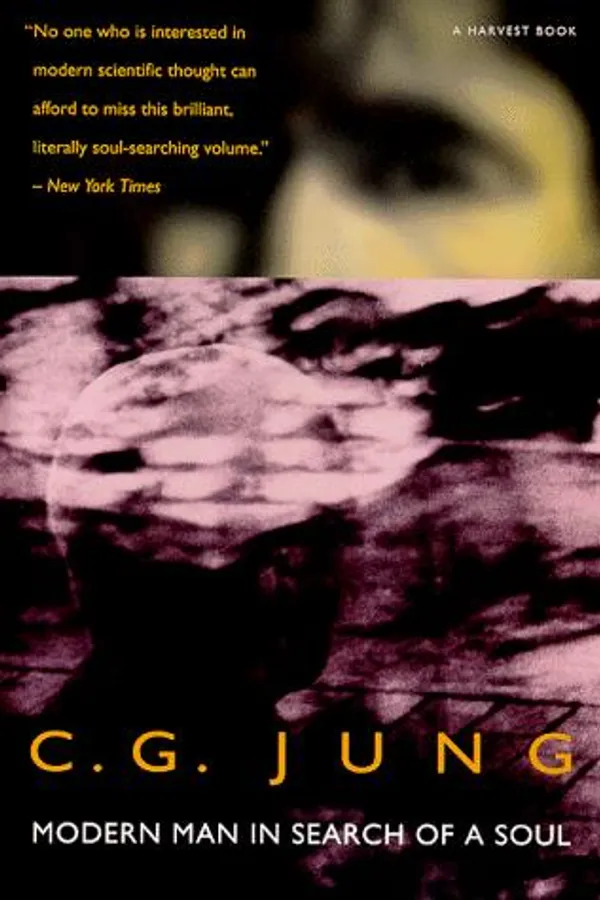
Modern Man in Search of a Soul
C. G. Jung
Modern man cured himself of superstition by amputating the symbolic life, and the operation succeeded; the ache he brings to the consulting room is the missing limb.
- TYPE
- Book
- SHELF
- Psychology & Behavior
- TIME
- 13 min read
- ADDED
- 2026 · 07 · 07
- STATUS
- Completed
- IDEAS
Psychology · Spirituality · Philosophy
Why it matters
The clearest diagnosis I know of the hunger that efficiency cannot feed, written by a clinician who watched successful men arrive at his door empty.
Eleven essays from Jung's middle period, assembled for English readers in 1933, and less a book about psychotherapy than a physician's report on a civilization. The patient is modern man: capable, conscious, freed by science from the creeds and rites that once carried the psyche's weight, and presenting with a complaint no laboratory can locate. Jung reports that a large share of his practice suffered from no definable neurosis, only from the senselessness of lives that worked perfectly. The essays supply the anatomy: dreams as the psyche's plain speech, compensating the waking attitude rather than disguising a wish; life as morning and afternoon, each with its own program, the afternoon ruined by running the morning's; archaic man not as fool but as psychologist, holding himself together with symbols we discarded without replacing. It ends where Jung's honesty forces it: with the report that his patients past thirty-five were all, in the last resort, seeking a religious outlook, and that none was truly healed without one. The claim is clinical, not devotional, which is why it cuts.
- Modern man is not everyman but the rarer case: fully conscious of the present, severed from tradition, and proud of the severance; his freedom and his complaint are the same fact.
- Dreams compensate rather than disguise: the dream is nature stating the psyche's position in its own language, and it does not lie, though it is routinely unread.
- Life has a morning and an afternoon, and the afternoon cannot be lived by the morning's program; what was true at twenty becomes a lie at forty-five.
- A large fraction of the clinically healthy are the actually sick: no definable neurosis, only a senselessness their success cannot answer; meaninglessness is an illness with no organ.
- Archaic man's symbols and rites were a working technology for containing the psyche; a culture that scraps them inherits the containment problem raw.
- Of his patients past thirty-five, Jung reports that every ultimate problem was the want of a religious outlook in the widest sense; the consulting room inherited the parish without its answers.
The argument
The essays were written separately, as lectures and papers, and assembled for English readers in 1933, and they still read as one continuous diagnosis. The patient is a civilization. Jung’s modern man is not everyone alive in the twentieth century; he is the rarer case, the man standing at the edge of the present with the whole of history behind him and none of it binding: fully conscious, competent, unsuperstitious, and estranged. The Great War sits underneath every page. A generation had watched the machinery of progress process bodies, and the confidence that science and organization would deliver a life worth living did not survive the demonstration. What replaced that confidence, Jung argues, was not a new faith but a vacancy; the psyche, carried for millennia by creed, rite, and symbol, was suddenly carrying itself.
Into his consulting room walked the evidence. Jung reports that a large share of his practice, he put it at about a third, suffered from no clinically definable neurosis at all; these patients suffered from the senselessness and emptiness of their own lives, and their success was part of the presentation. The observation forces a revision of what therapy is for. For the young patient the aim is adaptation: work, love, a footing in the world. But normality is a cure only for those who failed to reach it. For the man who has achieved it and finds it hollow, normality is the disease, and a therapy that can only restore him to it runs in a circle. The second kind of patient does not need repair. He needs meaning, and Jung is blunt that no technique manufactures meaning; it has to be found, and the finding is the treatment.
The instrument of the finding is the unconscious, and the essays on dream analysis mark the break with Freud. For Freud the dream is a disguise, a censored wish to be interrogated until it confesses. For Jung the dream is a statement: nature reporting the psyche’s actual position in its own language, compensating the one-sidedness of the waking attitude. The dream does not deceive; it is merely unread, and the analyst’s work is translation rather than cross-examination. The deeper split follows the same line. Freud’s psychology is causal and reductive, tracing every present structure back to an old wound, and built, Jung observes, on the study of the sick. His own is prospective: the neurosis is not only a debt but an attempt, a botched effort of the psyche to move forward, sometimes carrying the seed of its own cure. A symptom, on this reading, is not just what went wrong; it is what the psyche is trying to do next, executed badly.
The essay on the stages of life carries the book’s most portable claim. Life has a morning and an afternoon. The morning’s program is given by nature: establish yourself, win a footing, found a family, achieve. Culture is well equipped for the morning, with schools, careers, and applause. The afternoon has a different program, inward, concerned with meaning rather than expansion, and for the afternoon the culture provides nothing at all. We enter the second half of life wholly unprepared, and worse, we enter it assuming the morning’s truths will serve, when what was true at twenty has quietly become a lie at forty-five. The neuroses of the second half are mostly this, on Jung’s account: the afternoon lived on the morning’s program, achievement pursued past the point where it answers anything.
Two essays widen the frame. Archaic man, Jung insists, was not a fool waiting for chemistry to be invented. His participation in symbol and rite was a working technology, a means of containing psychic forces that do not become less real when they become less named; modern man scrapped the containment and kept the forces. The companion essay on the spiritual problem of the age reads its fashions, the sudden appetite for psychology itself, for spiritualism, for imported Eastern practice, as symptoms: a civilization improvising containers because it burned its own. Psychology, Jung concedes, exists because the symbols died. A churched century would not have needed him.
The closing essay states the conclusion the whole book has been walking toward, and states it as a clinical datum rather than a devotion. Among all his patients past thirty-five, Jung reports, there was not one whose ultimate problem was not the want of a religious outlook on life, understood in the widest sense, and not one was truly healed who did not recover it. The consulting room had inherited the parish. And the inheritance is heavier than the profession admits, because the treatment is not a technique. Every patient is a new problem; theories are aids to be set down at the door; the doctor heals with what he is and cannot take a patient further than he himself has gone. What the book leaves standing in the church’s place is a profession of secular priests, formed by nothing deeper than their training, and Jung’s unease about that is visible and earned.
Working notes
Becker completes this book. Jung documents the vacancy where the symbols stood; The Denial of Death names the load the symbols were bearing, which is the terror of a creature that knows it dies. Read in either order they make one argument. Jung shows the patient presenting; Becker supplies the etiology; neither offers the consolation that the vacancy can be filled by reading about it.
The Secret of the Golden Flower is the practical sequel. Having diagnosed the West’s lost interior technology, Jung went looking where the manuals survived, and his commentary on that Chinese text carries a warning that aged better than the fashion it addressed: the West cannot borrow the East’s forms without its centuries, and imitation produces costume, not transformation. Imported practice as decoration is the disease dressed as the cure.
The diagnosis predates its own best evidence. Jung watched the vacancy before anyone had monetized it; the feed had not yet been built that fills every silent interval with pastime. His modern man had to go looking for distraction. Ours is defaulted into it, and the senselessness he found in a third of his practice now has infrastructure and a business model. The essays read stronger now than they can have read in 1933, which is a dark compliment to pay a book.
I take the religious-outlook claim as an outcome report, not an apologetic. A physician with decades of cases states a regularity: none healed without. The sample can be disputed; the register cannot be waved off. It is the register in which a structural engineer tells you which walls are load-bearing, and it deserves the same hearing, especially from readers who would prefer it false.
Meaninglessness is an illness with no organ, and its first symptom is the perfect functioning of everything else.
The types essay reads differently after enough hiring and enough partnerships. Introversion and extraversion are not personality trivia; they are two economies of energy, and most chronic misjudgments of people are category errors between the two. Jung offered the types as a rough compass. The compass stays useful only if you refuse to let it become a verdict.
A second reading corrects the first. The first time through, the book flatters: you recognize yourself as the conscious man. The second time it accuses: consciousness of the vacancy is not exemption from it, and knowing the diagnosis is the modern way of avoiding the treatment.
The quietest theme is solitude. What Jung calls the psyche’s demands cannot be heard at operating tempo; the essays are, among other things, an argument for scheduled interiority: not leisure, which fills, but solitude, which listens. That one distinction does the work of a whole self-help shelf, and it costs more than the shelf does.
Where I push back
The empiricism is a costume worn over a metaphysics. Jung claims the physician’s ground, facts observed at the bedside, while asserting entities, the collective unconscious first among them, that no bedside can confirm; an inference is delivered with the confidence of an observation, and the slippage runs through the whole book. He is entitled to the hypothesis. He is not entitled to the register in which he states it.
Second, the vagueness is load-bearing. A religious outlook in the widest sense is defined so widely that no life can falsify it: the atheist who finds gravity in his work is counted in, the churchgoer who found nothing is explained away. A claim that cannot fail has left the clinic, whichever room it is announced in, and Jung’s central claim cannot fail.
Third, the flattery. The reader is invited to recognize himself as the rare, fully conscious modern man, and the diagnosis doubles as a distinction; alienation becomes a boutique. Jung did not invent the market for sensitive suffering, but this book furnished its front room, and a century of spiritual consumerism has shopped there since.
The types chapter earned a specific afterlife it never asked for: a rough sketch of attitudes hardened, in other hands, into personality products that sort employees like fasteners. A book is not guilty of its descendants; it is accountable for how easily they were begotten, and this one made it easy.
Last, the book has no economics. A man’s emptiness sometimes has a balance sheet under it rather than an archetype, and a practice drawn from patients who could afford Zurich analysis never quite meets that man. The essays universalize a clientele. The diagnosis of the successful and hollow is permanent; its presentation as the condition of modern man mistakes the waiting room for the world.
How it enters the work
The stages essay runs in my life as a standing audit. A builder’s temperament is a morning temperament: establish, expand, ship; and nothing inside the temperament announces when the program has expired, because the program grades itself and always passes. So the question is put deliberately, in solitude, at intervals: which half am I in, and which program is executing. The companies are morning work and honest work. The essays, this archive, the spiritual inquiry are afternoon work begun on purpose before the afternoon forces the issue, because Jung’s waiting room teaches the cost of deferral: every man in it had deferred.
Solitude is the mechanism, and the practice is scheduled rather than awaited. Jung’s argument stripped to one instruction says: make room in which the psyche can be heard, and defend the room. The dusk work does double duty here. A long exposure is held attention, minutes of standing with one frame while the light does its slow work, intervention refused, and it is the nearest thing I have to what Jung means by symbolic life: an act with no efficiency case, performed because it holds something that has no other container. The black-and-white instinct is the same motion turned inward. Find the structure, then remove everything that isn’t it: a rule written for buildings and light that turns out to be executable on a self.
The inquiry itself is conducted with Jung’s sobriety, function over comfort. The question brought to any practice, meditation, scripture, rite, is his: what does this hold, and what happens to the load if I put it down. It is a colder question than belief and a more honest one, and it keeps the inquiry from decaying into the exact modern disease the book describes, traditions sampled as aesthetics, symbols worn as accessories.
And the archive is itself an answer to the closing essay. If meaning has to be found rather than manufactured, the finding needs a discipline, and these working notes are mine: reading as rite, judgment recorded, the interior work given a form that survives the mood that produced it. Jung would have called that a symbol in the making. I call it maintenance, and the two descriptions do not disagree.
- Name which half of life you are in and which program you are running; achievement goals do not transfer to the afternoon.
- Treat recurring dreams and moods as reports, not noise; the psyche files its position whether or not you read the filing.
- Do not remove a symbol, rite, or discipline from a life until you can name the function it performed; the load remains after the container is gone.
- Take meaninglessness as seriously as illness; a life that works perfectly and means nothing is a clinical presentation, not a mood.
- Bring a clinician's question to spiritual practice: not what is comforting to believe, but what holds under load.
The vagueness is load-bearing: soul, psyche, and religious outlook are left wide enough that a reader can pour in whatever he already wanted, and most do. The book presents itself as empirical while its central postulates cannot be falsified, and its descendants include as much commercial mysticism as serious interior work. Taken as diagnosis it is permanent; taken as license it will bless self-indulgence in clinical vocabulary.