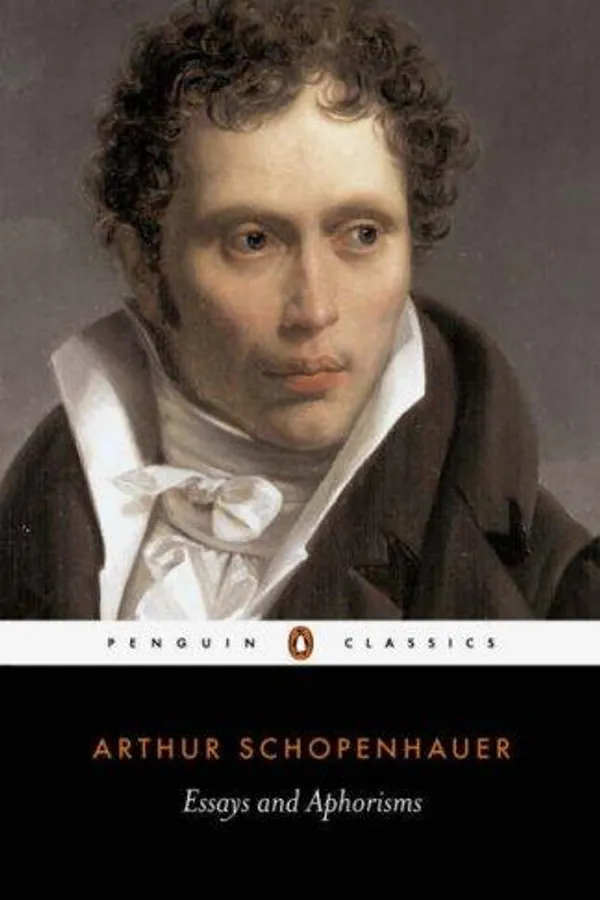
Book
Essays and Aphorisms
Arthur Schopenhauer
Life swings between pain and boredom because the will can only want; the honest responses are art, compassion, and a solitude held with discipline.
- TYPE
- Book
- SHELF
- Philosophy & Self-Command
- TIME
- 13 min read
- ADDED
- 2026 · 07 · 07
- STATUS
- Completed
- IDEAS
Philosophy · Art
Why it matters
Schopenhauer is the control group of this shelf: whatever consolation survives his contempt has earned the right to be believed.
A selection from Parerga and Paralipomena, the late essays of 1851 that finally made Schopenhauer famous after three decades of being ignored, translated for Penguin by R. J. Hollingdale. Underneath the essays sits the one system he ever built: the world as will, a single blind striving of which every individual is a temporary expression, so that desire is lack, satisfaction is brief, and existence swings on a pendulum between pain and boredom. Happiness on this account is negative, the absence of suffering rather than a positive quantity, and every plan that forgets this is a scheduled disappointment. From that cold ground the essays work outward into counsel: on thinking for yourself against the substitute of reading, on style as intellectual honesty, on noise, on suicide, on the suffering of the world, on women, this last a disgrace the reader must walk past with eyes open. Art receives the highest office: in aesthetic contemplation the will goes quiet and the observer, briefly, stops wanting. Compassion, the recognition of one striving behind all sufferers, grounds the ethics. It is the most readable pessimism ever written, and the prose is the discipline the doctrine demands.
- The will is primary and the intellect is its instrument: men do not desire things because they judge them good; they judge them good because they desire them.
- Happiness is negative, the removal of a pain rather than a positive possession. Satisfaction extinguishes the desire that gave it value, and boredom stands ready behind every fulfilled wish.
- Aesthetic contemplation is temporary release: before the beautiful the observer stops wanting and becomes, for a while, a pure subject of knowing. Art is respite from the will, not victory over it.
- Solitude is the tax on inner worth: society runs on mutual accommodation, and the price of company is paid in self. The man with resources in himself loses least by staying home.
- Reading is thinking with someone else's head, and done constantly it replaces the capacity it was meant to feed; a large library can be a way of never having a thought.
- Style is the physiognomy of the mind: obscurity in prose is never depth but either confusion or fraud, and clarity is a form of good faith with the reader.
- Compassion is the whole of ethics: the recognition that one and the same will suffers in every creature dissolves the border that egoism spends a lifetime defending.
The argument
The book is a harvest gathered thirty years late. Schopenhauer published his system, The World as Will and Representation, in 1818, and the world declined to notice; he spent the following decades in Frankfurt, unemployed by any university, writing the essays and fragments collected in 1851 as Parerga and Paralipomena. Those essays, not the system, made him famous, and Hollingdale’s selection preserves the reason: here the metaphysics has been compressed into counsel, the architecture into aphorism, and a philosophy that failed as a treatise succeeded as a voice. The failure of the first career is load-bearing. A man who has already lost the audience writes for no one’s approval, and it shows on every page: no flattery, no fashion, no accommodation of the reader’s hopes.
The doctrine underneath is stated quickly and never softened. The world as we meet it is representation, appearance ordered by the mind; the reality beneath appearance is will, a single, blind, objectless striving of which every creature is a temporary expression. From this everything follows with unpleasant economy. Desire is a lack, so wanting is a form of suffering; satisfaction merely removes the lack, so it is felt as relief rather than as possession, and it is brief. When pain retreats, no positive happiness flows in to occupy the ground; boredom does. Life therefore swings between the two poles, pain when we want and boredom when we have, and the swinging itself is the will’s signature. His proof of the vanity of existence is the honest one: if being alive carried positive value, merely being alive would satisfy, and an idle hour would be a pleasure instead of a weight.
The essay on the suffering of the world draws the practical conclusion without blinking. If existence is structured as penalty, then the sane frame is to treat it as a place of correction, and to treat every other person as a fellow prisoner rather than a rival claimant. What sounds like despair issues, strangely, in gentleness: the appropriate address between human beings, he argues, is companion in suffering, and from that address flow the tolerance, patience, and charity that moralists demand on weaker grounds. This is where his ethics stands: not duty, not contract, but compassion, the felt recognition that the border between me and the other is an artifact of appearance, and that the will which suffers in him is the will that suffers in me.
Art holds the highest office the system can grant. In aesthetic contemplation the intellect slips the will’s harness: the observer confronts the object without reference to his own advantage, stops wanting, and becomes for the duration of the looking a pure subject of knowing. Genius, on this account, is not talent but surplus, an intellect large beyond what the will requires for its errands, and therefore free to hold the world as an object instead of a menu. The release is real and it is temporary; art is furlough, not pardon. Only the saint’s full denial of the will goes further, and Schopenhauer, candid as ever, does not claim to have gone there.
The counsel essays spend this metaphysics in daily currency. On thinking for yourself: reading is thinking with another man’s head, useful when one’s own spring runs dry, corrosive when it becomes the default, and the scholar who reads constantly reads himself stupid. On style: prose is the face of the mind, obscurity is either confusion or imposture, and the celebrated fog of German academic philosophy, Hegel’s above all, is fraud in a professor’s gown; he says so with a relish that has kept the passage alive for one hundred seventy years. On noise: the tolerance of racket is inversely related to the worth of the mind being interrupted, and the cracking of carters’ whips in the street is his chosen atrocity. On suicide: he defends the act against clerical condemnation and then denies it metaphysically, since it destroys the individual while affirming the will, ending the sufferer but not the sentence. And on women there is the notorious essay, which is not analysis but grievance in costume, and which I read once and do not intend to defend.
The prose is the argument’s final exhibit. A philosophy that indicts the world for disorder is obligated to be orderly, and he pays the obligation in full: short essays, exact nouns, verdicts delivered and left standing. The doctrine says the will deceives; the style refuses to.
Working notes
Nietzsche stands behind this book the way a son stands behind a father’s coffin, inheriting and quarreling at once. Beyond Good and Evil keeps the whole diagnosis, the primacy of drives beneath reasons, the intellect as advocate rather than judge, and reverses only the verdict: where Schopenhauer says the will convicts life, Nietzsche says the will is life and the conviction is cowardice. Reading them in sequence is the useful exercise, because the disagreement is not about facts. Both men look at the same animal. One recommends sedation, the other a harder saddle, and the choice between them is made by temperament and then defended by philosophy, which is exactly what Schopenhauer’s own psychology predicts.
Seneca makes the other instructive contrast. On the Shortness of Life audits time: life is long enough if none of it is surrendered to the trivial. Schopenhauer audits wanting: the time was never the problem; the wanting is, and a man who reclaimed every hour would still spend them on the pendulum. The Stoic sells a discipline of use, the pessimist a discipline of expectation, and I have found the second more durable, because it keeps working on the days the first fails. Lower the price you expect from satisfaction and most of the ordinary disappointments arrive pre-paid.
The boredom analysis is the sharpest instrument in the book, and it has only appreciated. An economy now exists whose entire revenue is the second pole of his pendulum: the feed, the notification, the infinite scroll are boredom-arbitrage, machinery for reselling relief from an emptiness they also manufacture. Schopenhauer priced satisfaction honestly in 1851 and thereby described the attention business a century and a half early. The pendulum was not repealed by abundance. Abundance industrialized it.
Tanizaki belongs beside him, oddly. In Praise of Shadows finds value in what is withheld: the dark alcove, the dulled surface, the light that arrives already spent. That is negative happiness translated into aesthetics, the beauty of absence rather than of acquisition, and it convinces me that Schopenhauer’s coldest thesis has a warm use. If the positive is always a bait, then the arts of subtraction, shadow, silence, and empty space are not austerity but accuracy.
What only became visible on a second reading: the book’s severity is a form of respect. He assumes the reader can bear the sentence unsoftened, and the assumption is flattering in a way no encouragement ever is. Consolation literature comforts by lying about the odds. This book comforts by demonstrating that a man saw the odds whole and still kept his desk in order, walked daily, and filled volume after volume. The doctrine says resignation; the shelf of his collected works says otherwise, and I trust the shelf.
Where I push back
The system is a temperament wearing the costume of a cosmology. From the premise of the will, nothing in the pendulum argument follows necessarily; a disposition chose the evidence, and the evidence then vouched for the disposition. His pessimism is unfalsifiable in the precise sense: every joy is reclassified as relief, every satisfaction as a receipt for a debt, and no possible experience is permitted to count against the thesis. That is not an audit of life. It is an accounting policy, adopted in advance, that guarantees the books show a loss.
The biography also testifies against the ledger. He preached compassion as the whole of ethics and paid a court-ordered annuity for years to a seamstress he had injured in a stairwell quarrel; he denounced striving from the security of inherited capital that spared him ever having to strive. And Nietzsche’s needle finds the vein: a pessimist who dines well, guards his health, and plays his flute daily is running a surplus his philosophy cannot explain. None of this refutes the arguments. It does establish that the author could not live inside them, and a doctrine its own maker cannot inhabit should be quoted with the humility he never showed.
The essay on women is worse than wrong; it is corrupting to the book around it, because it demonstrates the method failing openly. The same man who insists that clarity is good faith and that the intellect is the will’s advocate produces, on this subject, an advocate’s brief for a private resentment, written in his best prose. It is the book’s own thesis performed as a confession, and the reader who excuses it has missed the lesson it accidentally teaches: style can launder anything, which is precisely why the stylist must be watched.
And the counsel of solitude, taken neat, is bad medicine for most men. He mistook his own extraordinary self-sufficiency for a general prescription. Most character is built in friction, most delusion survives best in private, and the man who withdraws on Schopenhauer’s authority usually curates an audience of one and calls it independence.
How it enters the work
The photography took his fingerprints before I knew whose they were. Black and white is negative happiness as a visual grammar: the frame improves by removal, color surrendered, event surrendered, until what remains is structure and light. The long exposures go further; minutes of open shutter erase traffic, crowds, and weather, every transient want the scene contains, and hand back the thing that was standing still underneath. My operating instinct, find the structure and remove everything that isn’t it, is a method of subtraction, and this book is the metaphysics of subtraction: the conviction that the positive is noise and the essential is what survives its removal. Whether or not the will convicts the world, the discipline of expecting nothing from ornament has made every one of my strongest frames.
His account of contemplation is, in the exact sense, a description of the working state. A camera pointed with appetite produces inventory: the trophy view, the frame that wants something from the viewer. The state Schopenhauer names, attention with the wanting gone, is the state in which composition actually happens, and it can be trained; standing behind a tripod in the dark waiting on a lighthouse is the drill. Fineara sells prints, but the seeing that makes them cannot itself be acquisitive, and this book is the clearest statement I own of why.
Solitude I hold as he taught, with his accounting and against his conclusion. The hours alone, on ridgelines, on empty waterfronts before dawn, at the desk with the year’s work spread out for cutting, are the productive capital of everything I build, and I schedule and defend them without apology; his tax metaphor made the defense articulate. Company costs self; solitude costs warmth; a man should know which bill he is paying and pay it deliberately. But I refuse the alibi. The withdrawal is instrumental, priced, and temporary, a working position and not a residence, because I watched what the book becomes when it is swallowed whole: a license for contempt, issued by the one authority that never audits. Schopenhauer is the coldest mind on this shelf, and the correct use of him is the one he prescribed for art itself: enter, be clarified, and come back out.
- Price every desire at the day after its satisfaction; if the purchase only removes a pain, say so before paying.
- Hold solitude as working capital, scheduled and defended, never as a grievance against the world.
- Write clearly or concede you have nothing; obscurity is advertising for empty inventory.
- Use art as training in attention without appetite: look until the wanting stops, then keep looking.
- Stop reading the moment it starts substituting for thinking; a book is a prompt, not a prosthesis.
The pessimism is a temperament argued into a cosmology, and it flatters the melancholic reader into mistaking his mood for insight. The essay on women is bile dressed as observation and should be read, if at all, as evidence of how a first-rate mind launders a private wound into doctrine. And the counsel of withdrawal is dangerous to men who still need the friction of others: taken whole, it converts solitude from an instrument into an alibi.